How to Read a Public Consultation Without Mistaking It for a Decision
A clear method for reading a public consultation: identify its real question, what responses it invites, and which decisions officials still must make.
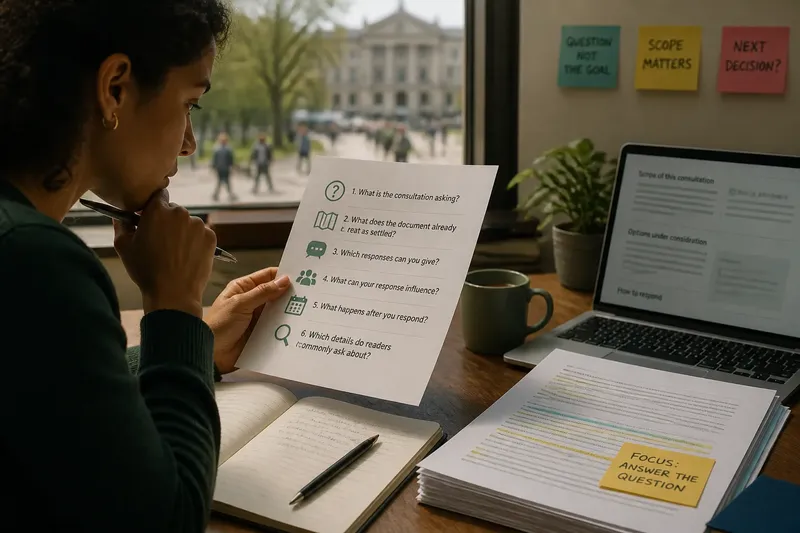
You open a public consultation on your phone and find a long document, a deadline, and a form asking for your views. Before deciding what to write, use this map for reading a public consultation: identify the question officials have put forward, the responses they can use, and what remains undecided.
What is the consultation actually asking?
Start with the consultation notice, not the first policy claim that catches your eye. Look for a sentence that directly asks for input. It may ask whether a proposed rule is workable, which of several options is preferable, or what effects officials should consider.
Then distinguish the stated purpose from the question itself. A notice might say the government wants to improve access to a service, while asking whether a proposed eligibility rule is clear. The broad aim supplies context; the narrower question sets the response officials are seeking now.
Write the question in plain language. For example: “Are officials asking how to implement this option, or whether to choose it?” That distinction prevents you from treating a request for implementation feedback as an open invitation to redesign the entire policy.
What does the document already treat as settled?
Read the background, scope, and options sections for assumptions that shape the conversation. A consultation may take the policy goal as given while inviting comment on how to reach it. Another may present several possible approaches and ask which should advance. Neither format, by itself, tells you what the final decision will be.
Mark language that sets boundaries: “within the scope,” “under consideration,” or “not addressed here.” These phrases show which matters the document has placed inside or outside the current exercise. If a central concern falls outside the stated scope, you can still raise it, but recognize that the form may not be designed to resolve it.
Also note what is missing. If the document describes an option without explaining how it would work for a particular group, that gap may be a useful response. Phrase it as a question or request for clarification rather than assuming the omission proves officials have ignored the issue.
Which responses can you give?
Check the response form before drafting. It may use open-ended questions, fixed choices, or a mix. Some forms ask for evidence or practical examples; others invite a short comment on each proposal. The format affects how to make your point legible, not whether your view matters.
- For a choice between options, state your preference and the reason behind it.
- For a proposed rule, identify the wording or requirement you are responding to.
- For an implementation question, describe the practical obstacle or condition that officials should account for.
- For an open comment box, lead with one clear point, then explain its relevance to the consultation question.
Say you run a neighborhood food pantry and a consultation asks whether a new reporting form is workable for small community providers. You could explain that volunteers rotate and do not all have access to the same records, then ask whether the form can accept information from a designated coordinator. That response connects a concrete starting situation to the question officials posed and gives them a specific issue to consider.
What can a consultation response influence?
A response can help officials understand how a proposal reads in practice, identify overlooked effects, compare options, or improve details. The consultation document should indicate which of those purposes applies. Look for the stated audience, the decisions under review, and any account of how responses will be considered.
But an invitation to comment is not the decision itself. The consultation may inform a later choice made by a minister, agency, council, or legislature, depending on the policy and the rules governing it. It may also be one input among legal requirements, operational constraints, and other forms of advice.
Do not infer that every response will be accepted or that a particular option is already selected. Instead, ask what decision follows this consultation, who is responsible for making it, and whether the notice explains when or how the outcome will be reported.
What should you look for after responding?
Before submitting, note the closing date, the permitted submission route, and whether the form allows supporting material. Follow the instructions for file types and personal information. If the process provides an acknowledgment or reference number, keep it with your copy of the response.
After the deadline, look for a consultation response or outcome notice on the agency’s website. Such a document may summarize themes, explain changes, or state why suggestions were not adopted. If no publication date is given, check the consultation page later rather than assuming that silence means a particular result.
Which details do readers commonly ask about?
Is a public consultation a vote?
Usually, it is a way to gather views and information, not a ballot that directly determines the outcome. Read the notice for the decision process and the role assigned to public responses.
Can I comment on an issue outside the questions?
You can often raise a relevant concern, especially if the form has an open comment field. Make clear how it connects to the stated purpose, and recognize that officials may not address matters outside the consultation’s scope.
Should I answer every question?
Answer the questions you can address clearly; a focused response is more useful than filling space with guesses. If a question does not apply to your experience or expertise, say so briefly or leave it blank if the form permits.
Where can I tell what happened afterward?
Check the consultation page and the responsible agency’s publications for an outcome notice or response summary. The notice may explain the next decision, but it does not necessarily settle every related policy issue.
How can you keep your response on target?
Use a simple reading sequence: identify the question, note the boundaries, inspect the response format, and locate the next decision. Then write one point at a time, tying each comment to a proposal or an effect officials can assess. This keeps your contribution grounded in the consultation rather than in assumptions about what it has already decided.
The useful habit is to separate being heard from having a proposal adopted. A public consultation gives you a defined opening to supply reasons, practical knowledge, or a concern the document has not accounted for. Reading its boundaries carefully helps you use that opening—and recognize which choices remain for the decision-makers.